nt3d#
A small 3D scene engine for Go programs that draw in the terminal or the browser. Build a scene of meshes, points, lines, and textures, point a camera at it, and nt3d renders it on the GPU with WebGPU, in software when there is no GPU, or as wireframe text when there are no graphics at all.
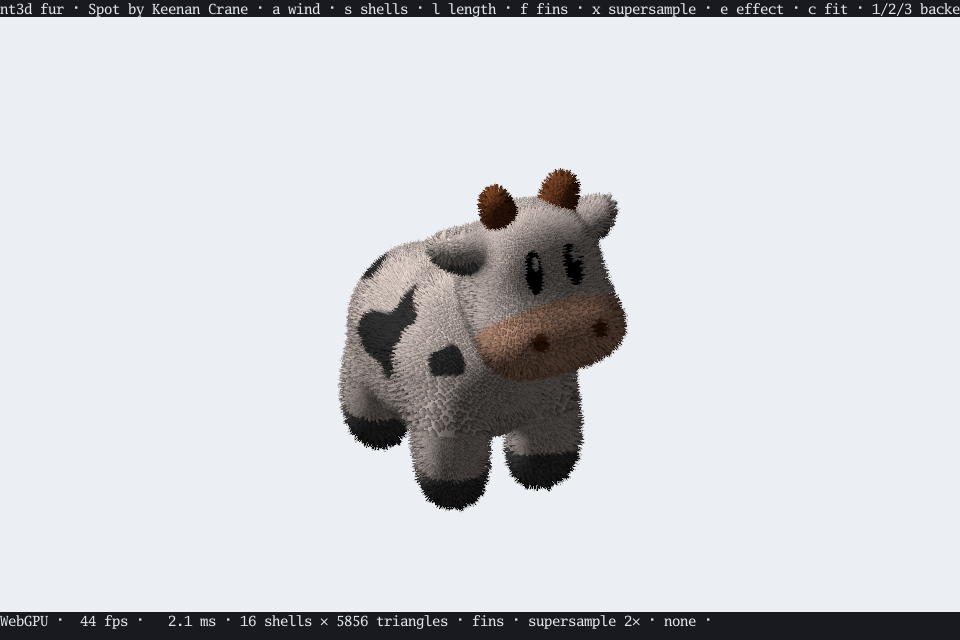
Try the demos in your browser → Every demo in the gallery is the same Go program you can run in a terminal, compiled to WebAssembly.
A first look#
scene := nt3d.NewScene()
ball, _ := nt3d.BuildSphere(nt3d.Sphere{Radius: .6, Color: orange})
scene.SetGeometry("ball", ball)

view := nt3dwidget.New(scene, 80, 24) // a Bubble Tea model you can drag to orbit
Getting started turns that into a complete program.
What it does#
- A scene graph of named nodes with transforms, visibility, and shared geometry, so a forest of a thousand trees costs one mesh.
- Clustered level of detail for point clouds and other large sets: cluster once, then cull and thin by distance each frame, on the CPU or in WebGPU compute.
- Three renderers that agree: WebGPU, a software rasterizer that draws the same picture, and wireframe for any terminal.
- Materials: textures with mipmaps, transparency, cutouts, highlights, fog, shader-generated textures, and shell fur.
- Mesh files: STL, OBJ, 3MF, PLY, and glTF, read safely within memory and size limits.
- A Bubble Tea widget that handles the camera, picking, Kitty graphics, and falling back when the GPU or the terminal can’t keep up.
Where to look#
- Guide: from a first program through scenes, materials, mesh files, and the widget.
- Demos: what each gallery demo shows, and how to run it.
- API reference: every type and function is documented in the source;
go doc nimbleterminal.dev/nt3dreads it.
Source#
nt3d is MIT-licensed, copyright Neomantra Corp. The source and issues are on GitHub.